
Researchers in the ZAP Group, under the direction of TMI-affiliate Zachariah Page, have designed a material that responds to visible light by changing the alignment of its molecules. By shining light of different intensities onto the material, they were able to control the degree of alignment in different regions.
Much like varying the shades in a grayscale image, this allowed them to "program" detailed images directly into a single thin film without using physical masks or complicated manufacutring techniques. Joy Zhou, a graduate student in Chemistry and part of the ZAP Lab, led the paper, "Chemically Amplified Photoalignment for Grayscale Programming of Molecular Order and Optical Anisotropy in Liquid Crystal Polymers," recently published in ACS Central Science.
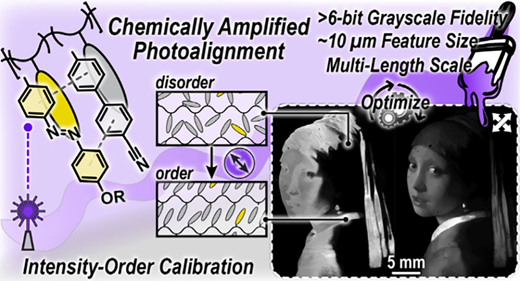
The team looked into how light interacts with liquid crystal polymers, which combine unique optical properties of liquid crystals with the durability and flexibility of plastics. Using a special type of liquid crystal polymer, the team was able to create highly accurate microscopic patterns and grayscale images with fine detail. They also developed a calibration method that improves the accuracy of the resulting patterns and works across both very small and much larger areas, making techniques practical for large-scale manufacturing.
Overall, this work opens new possibilities for next-generation optical devices that can manipulate light, control polarization, store information, and create dynamic visual effects.
Other contributers include Elizbeth Recker, McKetta Department of Chemical Engineering; Seth Allen, Department of Chemistry; Holden Robinson, Department of Chemistry; Jaechul Ju, Department of Chemistry; and Dr. Sean Roberts, Department of Chemistry.
