
Sodium-sulfer (Na-S) batteries are a promising option for storing large amounts of energy from sources like wind and solar power. However, their performance is often limited by undesired chemical reactions that reduce the battery life, slow charging and discharging, and cause the batteries to work poorly in cold temperatures. Min-Hao Pai, a recent Materials Science & Engineering alum under the supervision of Dr. Arumugam Manthiram, has designed a protective coating for the sulfur electrode that helped to prevent these performance issues.
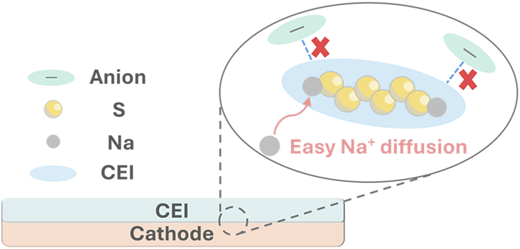
In this study, he compared two different battery electrolytes, one NaPF6- and one NaFSI-based, to better understand how they affect performace. While the PF6−-based electrolyte worked well with the sodium metal component of the battery, it reacted poorly with the sulfur-based compounds formed during operation, leading to faster battery degradation and failure.
Pai designed a protective coating that forms on the battery's sulfur electrode, prevents harmful side reactions, reduces the loss of the sulfur-containing compounds, and improves the battery's ability to repeatedly store and release energy. The battery also showed significantly better lifespans, faster charging and discharging performance, and good operations in cold temperatures.
These findings highlight the importance of controlling chemica processes at the electrode surface and domonstrates a practical strategy for developing high-performance sodium-sulfur batteries that can operate reliably in cold environments.
Read more at "Electrolyte engineering toward stable cathode–electrolyte interphases for accelerated sulfur conversion in low-temperature sodium–sulfur batteries" at the Journal of Materials Chemistry A.
