
Messenger RNA lipid nanoparticles, or mRNA-LNPs, are central to the development of vaccines and RNA-based therapeutics. However, their broader use is limited by two major challenges: much of the delivered mRNA can remain trapped inside cellular compartments called endosomes, and the nanoparticles can become unstable during frozen storage and thawing.
Meysam Mohammadi-Zerankeshi, a student in the Walker Department of Mechanical Engineering and under the supervision of TMI-affiliate Alexander Marras, led a study examining how storage-buffer composition affects the internal structure, freeze–thaw stability and delivery efficiency of mRNA-LNPs. The research brought together collaborators from several University of Texas at Austin departments, Boston University, and Eli Lilly and Company. The study evaluated three storage buffers—Tris, histidine and citrate—and LNPs containing three different ionizable lipids: LP-01, MC3 and SM-102.
LNPs are nanoscale particles composed primarily of lipids that encapsulate and protect mRNA while helping transport it into cells. Although freezing can reduce mRNA degradation during long-term storage, the freeze–thaw process can subject LNPs to ice formation, osmotic stress and changes in local chemical conditions. These stresses may cause particle aggregation, structural rearrangement and leakage or loss of the encapsulated mRNA. The researchers found that there was not one universally optimal storage buffer. Instead, citrate and Tris provided different advantages depending on whether the nanoparticles were evaluated before or after freezing.
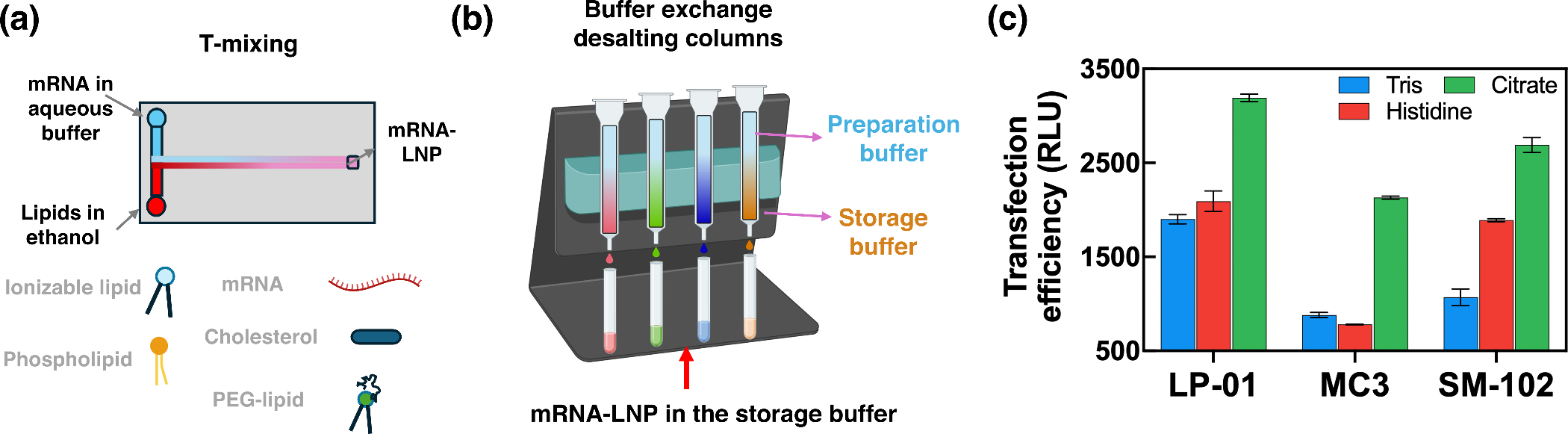
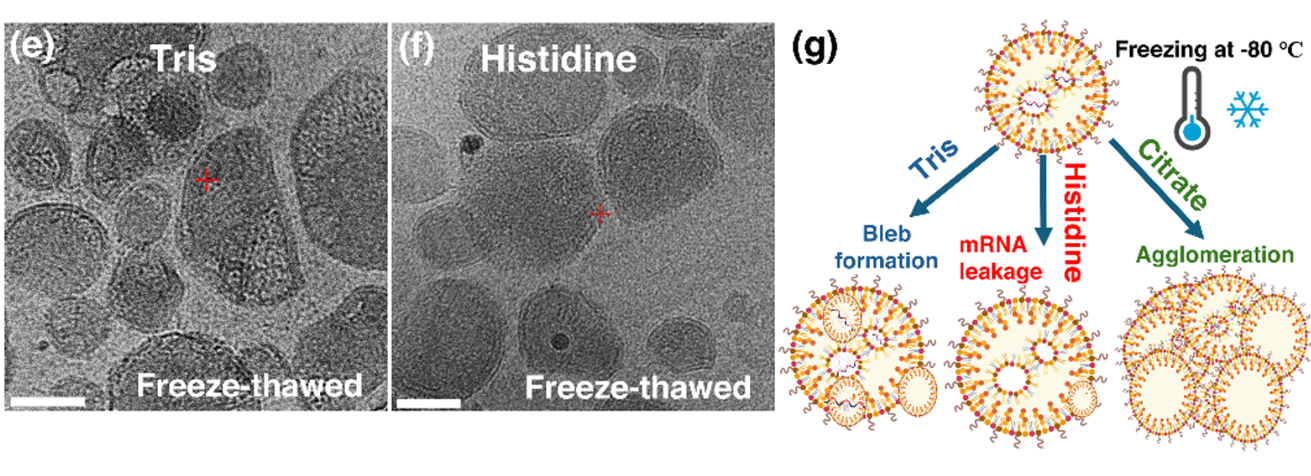
Before freeze–thaw, citrate-buffered mRNA-LNPs were the most successful at getting the genetic material into the cells across the three lipid formulations and four human cell lines tested. Citrate, however, did not protect the LNPs during freezing and thawing. In the tested LP-01 formulation, citrate-buffered particles showed extensive clumping of the nanoparticles after one freeze-that cycle and the particles lost their ability to contain the mRNA and deliver it into cells.
In the same LP-01 formulation, histidine-buffered particles showed intermediate stability, while Tris-buffered particles experienced comparatively small changes in size, encapsulation and biological activity. Tris also best preserved the tested formulations during one month of storage at both 5 °C and −80 °C. The concentration of Tris was also important, as increasing the concentration of the Tris buffer was found to better protect the mRNA during the freeze-thaw cycles and improved delivery efficiency.
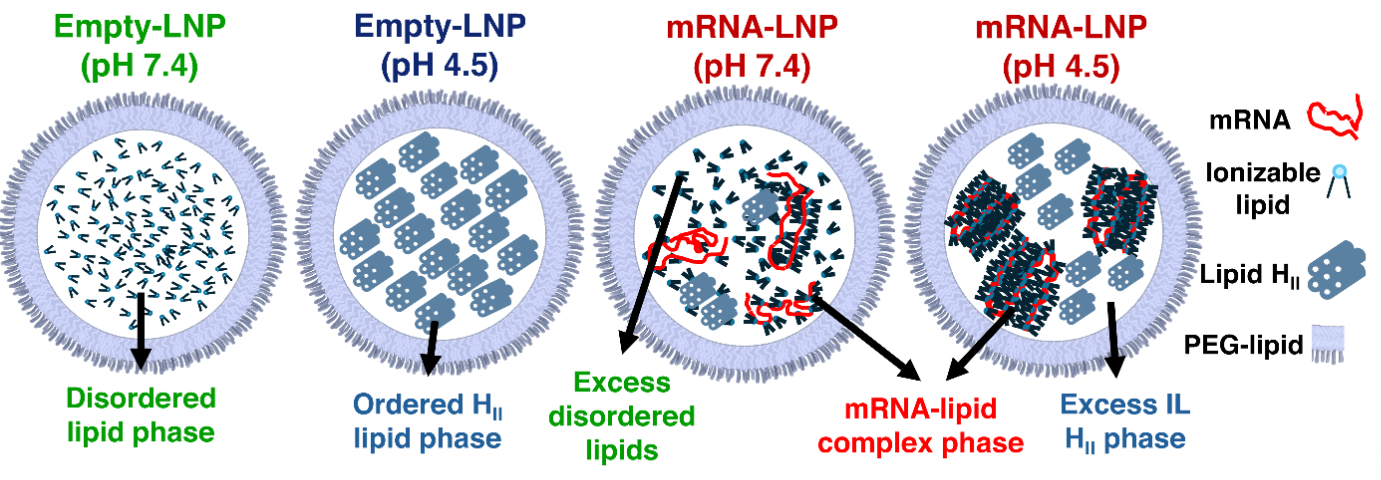
Instead of relying on identifying the best storage buffer through trial and error, the study provides molecular and structural explanations for how buffer identity, concentration and pH influence LNP morphology and performance. The results demonstrate that buffer selection should be treated as a critical formulation-design parameter: citrate may enhance the delivery efficiency of fresh formulations, while Tris is better suited to maintaining LNP integrity and potency during frozen storage and thawing.
These findings could support a more rational selection of storage conditions for future mRNA vaccines and therapeutics.
Read more about their research at "Storage Buffer Composition Impacts Internal Structure, Freeze–Thaw Stability, and Transfection Efficiency of mRNA-Lipid Nanoparticles," at ACS Nano. Fellow authors include Dylan J. Charland (Lilly Seaport Innovation Center) ; Keira A. Donnelly (UT Department of Biomedical Engineering) ; Geoffrey T. Nash (Eli Lilly & Co) ; Jiale Shi (Boston University's Department of Chemistry); Dipak N. Patil (Eli Lilly & Co); Julia Ennis (Lilly Seaport Innovation Center); Kenneth G. Rodriguez (Lilly Seaport Innovation Center); Sonia Corba (Eurofins PSS Insoursing Solutions); Noah A. Wambolt (Eurofins PSS Insourcing Solutions); Haocheng Chueh (Lilly Seaport Innovation Center); Khaled AboulFotouh (Walker Department of Mechanical Engineering); Mohammed R. Kawelah (McKetta Department of Chemical Engineering); Younghoon Oh (Lilly Seaport Innovation Center); Dennis Yang (Eli Lilly & Co); Ken K. Qian (Eli Lilly & Co); Qiang Cui (Boston University's Department of Chemistry); Keith P. Johnston (McKetta Department of Chemical Engineering); and Daniel A. Estabrook (Lilly Seaport Innovation Center).
